

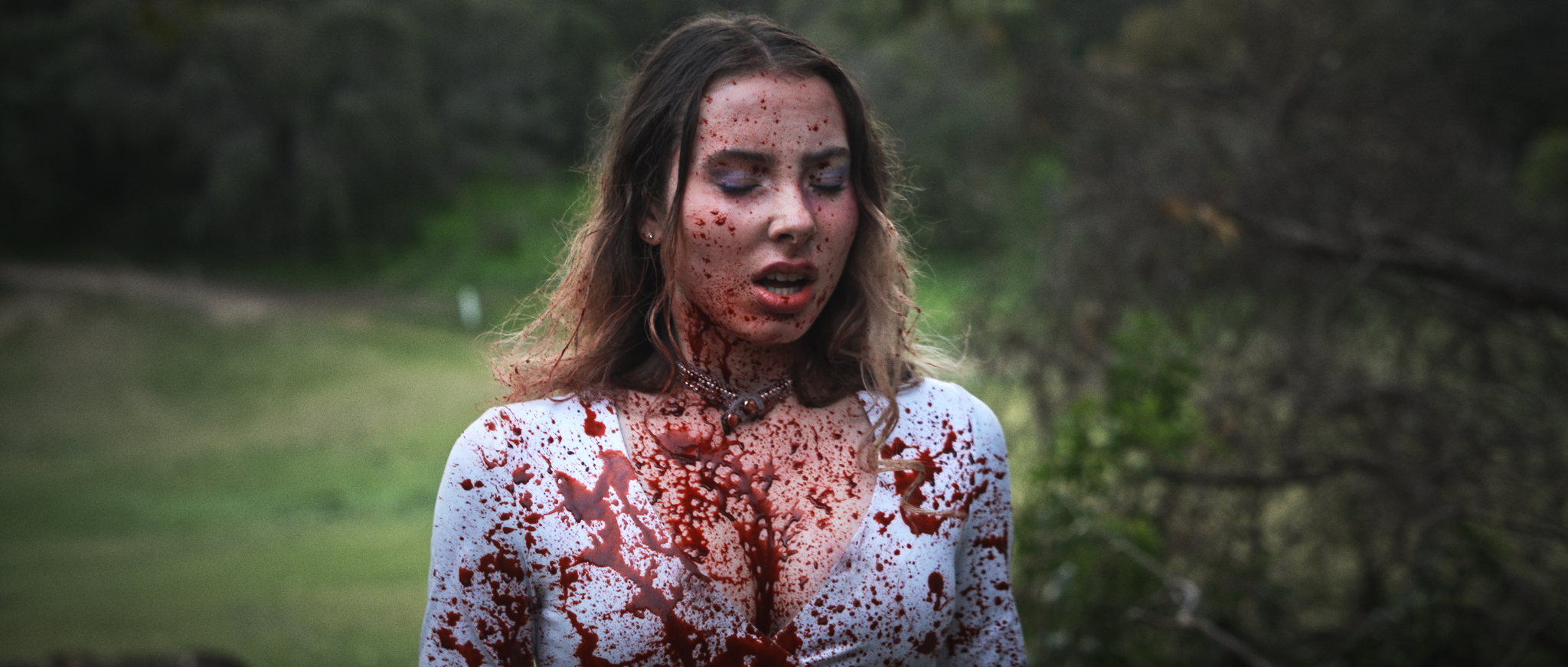
Shot across just 12 days in Preston Beach, Western Australia, The Hang Out brought together a group of twenty filmmakers and performers under one roof to create an unconventional slasher where the killer might not be the greatest threat.
Writer-director Ethan Powell’s latest feature, The Hang Out, takes the familiar ingredients of the slasher genre and throws them into a world of heightened personalities, dark comedy and complete chaos.
Produced through Nightmare Narratives, the film follows an ensemble of eccentric characters whose getaway takes a violent turn with the arrival of a mysterious killer known as The Hangman.
But there is a problem.
Even without a killer hunting them, this group might already be doomed.
The Real Killer Is Ego
At the heart of The Hang Out is a simple idea: what happens when everyone thinks they are the most important person in the room?
The characters are deliberately heightened. Their egos, insecurities and obsessions continually get in the way of the one thing they should be concentrating on: surviving.
While The Hang Out embraces the slasher genre, its comedy comes from treating these ridiculous personalities seriously. Arguments continue when people should be running. Personal grudges take priority over self-preservation. Characters remain trapped within their own worlds even as the situation around them becomes increasingly dangerous.
The Hangman himself isn’t immune to the film’s sense of humour.
He can be intimidating, violent and genuinely dangerous, but he can also be unexpectedly clumsy. Rather than diminishing the threat, the contrast is part of the film’s identity.
Because The Hang Out isn’t really about a group of perfectly rational people trying to outsmart an unstoppable killing machine.
It’s about deeply flawed people trying to survive themselves.
Killer or no killer, they’re in trouble.
12 Days in Preston Beach
Principal photography took place in Preston Beach, Western Australia, with the feature shot across an ambitious 12-day schedule.
Approximately twenty cast and crew members relocated to Preston Beach for the production, living and working together throughout the shoot.
It created an environment unlike a conventional film set.
The boundaries between cast, crew and everyday life quickly disappeared. The same people spending long days making the film were eating together, relaxing together, preparing for the following day’s scenes together and waking up to do it all again.
What began as a group assembled to make a feature gradually became a tight-knit community.
By the end of the production, many of the people involved no longer simply considered one another colleagues. They considered each other friends.
That connection became an important part of The Hang Out itself.
A Symbiotic Collaboration
While Powell entered production with a clear vision for the film, The Hang Out developed through what became a genuinely symbiotic collaboration between its cast and crew.
Ideas moved in both directions.
Actors discovered new elements within their characters. Crew members found creative solutions to the realities of an independent production. Moments evolved naturally on set, while everyone remained focused on creating the same film.
For Powell, that environment became one of the defining experiences of the production.
Rather than twenty individuals simply completing their respective jobs, the production developed into a group collectively invested in making The Hang Out as strong as it could be.
Independent filmmaking often requires that kind of trust. With an ambitious screenplay and only 12 days to capture a feature, there was little room for anything else.
Every department relied on another.
Every day mattered.
And everyone had a part to play.
A Slasher That Knows What It Is
The Hang Out doesn’t attempt to hide its love for horror.
There is a masked killer. There are chases. There is violence. There are terrible decisions.
But underneath the bloodshed is a satire about ego and the extraordinary ability people have to remain consumed by themselves even when everything around them is falling apart.
The Hangman may be carrying the weapon, but that doesn’t necessarily make him the most dangerous thing in the movie.
Sometimes stupidity is dangerous.
Sometimes arrogance is dangerous.
Sometimes refusing to listen is dangerous.
And sometimes the person coming after you with a weapon trips over something.
That’s The Hang Out.
The comedy never means the characters are safe, and the horror never means the film has to stop being funny.
From Preston Beach to Post-Production
Following the completion of principal photography, The Hang Out has now moved into post-production.
The next stage is about finding the final rhythm of the film: balancing its ensemble, sharpening its comedy and ensuring that when the horror arrives, it still carries weight.
For a production completed across just 12 days, however, The Hang Out has already left behind something beyond the footage captured on set.
Twenty people arrived in Preston Beach to make a movie.
They left having created a community.
That experience, the friendships formed and the willingness of everyone involved to throw themselves into the same strange, chaotic film became inseparable from the production itself.
The result is a feature built around ego but created through the complete opposite: collaboration.
And somewhere amongst all of it is The Hangman.
Dangerous.
Determined.
And occasionally a little unsteady on his feet.
The Hang Out
Written & Directed by Ethan Powell
A Nightmare Narratives Production
Leave a Reply